


Why the UK Underground Isn’t and Cannot Be a Genre
- Zhakiya Sowah
- Nov 30, 2025
- 4 min read

The term “UK underground” has become a convenient shorthand, deployed by journalists, tastemakers, and social media commentators alike. It is precisely this convenience that obscures the complexity and dynamism of the scene it aims to describe. By definition, genres are organised around shared sonic characteristics, conventional rhythms, and lineage: they signal to audiences what to expect and situate artists within broader musical narratives.

The UK underground label fails on all these counts. It is applied simultaneously to alternative producers and artists experimenting with post-genre electronic sounds, to rappers who remain commercially emergent yet align with mainstream sensibilities, and to breakout stars whose very presence resists categorisation. The underground is too wide, too hybrid, and too structurally fluid to be compressed into a single genre. What it represents instead is an ecosystem: a network of creative camps, independent outliers, and aesthetic and cultural logics, all coexisting in conversation and collision.
Genres suggest consistency: recognisable instrumentation, characteristic rhythms, and stylistic coherence. The UK underground revels in the opposite. When innovative producers like JayF, afrosurrealist, and fullstopnathan all exist under the umbrella of ‘underground,’ the descriptor ‘genre’ falls short. One of the scene’s defining traits is genre blending, in which a plethora of sounds emerge. Music here blurs lines between Trap, UK drill, US drill, Afroswing, Grime, Bouyon, and more. This diversity elevates producers as the primary architects and public faces of movements. Innovation and influence circulate through overlapping networks rather than a single, fixed style.
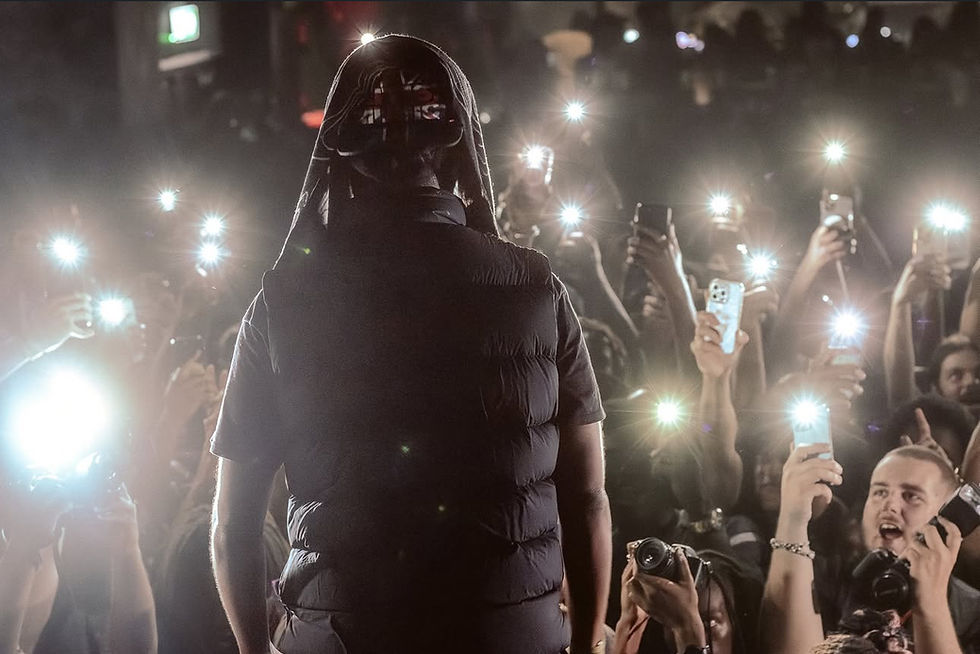
Artists and producers act as living embodiments of visual and sonic markers: their aesthetic, digital presence, and regional identity communicate as much as the compositions themselves. Sinn6r and the producer collective DBee exemplify drill-adjacent innovation. Sinn6r’s tape #FEDERAL carries the bounce of UK drill while departing from its percussive norms, drawing inspiration from Chief Keef’s Back From the Dead and QuitePvck, as noted by Riko. The dark clothes, the #FEDERAL bop, the artistry: they all convey cultural positioning. They exist as an example of the hyper-globalised, internet-native artists in the underground that synthesise US underground influences while reimagining UK styles. The result is music that is locally grounded yet globally conversant.

Emerging and continually reshaping itself, the scene is characterised by diversity in artistic practice and distribution strategies. While many artists operate independently, the more commercially successful are signed to labels, and all make use of digital streaming platforms. Some experiment with physical media such as vinyl or limited-edition releases, reflecting varied aesthetic and economic logics. This diversity signals that there is no consensus on how music should be produced, distributed, or monetised. Using Fabbri’s (1982) framework, this lack of shared economic and behavioural norms suggests the underground cannot be defined as a single genre. Similarly, Negus’s concept of genre cultures helps explain the coexistence of multiple organisational logics: organic, community-driven micro-scenes exist alongside label-supported, semi-synthetic practices, forming an ecosystem of overlapping yet distinct cultural formations.
The digital sphere reinforces this multiplicity. Platforms such as Twitter, SoundCloud, Bandcamp, and YouTube allow artists and fans to interact, circulate releases, and debate aesthetics. Within this broadly experimental ethos, no single sound or visual logic unites the scene. Instead, what connects these artists is their approach, mindset, and ethos in circulating and evolving through networks rather than prescriptive genre rules. Digital spaces both reflect and amplify the underground’s ecosystemic nature, fostering community and cultural exchange without collapsing its diversity into a homogeneous category.

Sinn6r’s hedonistic, brash artistry contrasts with Finessekid’s high-energy, trap-infused drill framework. Grime revivalists such as Saiming, Kibo, and Floetic draw from heritage sounds while reconfiguring them digitally. Ciel and N4T extend the lineage of Afroswing and UK dancehall into experimental territory. Ceebo’s Blair Babies, N4T’s GHANAMUSTGO, afrosurrealist’s Buy British, and Jim Legxacy’s Black British Music illustrate how, although there’s crossover in cultural logic, in this case, the explorations of Black British identity and its socio-political contexts, it can be executed through distinct sound lineages, which again undermines the concept of a genre.
EsDeeKid offers a particularly striking case study. His unprecedented commercial success both aligns with and challenges traditional conceptions of the scene. A masked rapper from Liverpool, he emerged in 2025 with viral singles like Phantom and his debut album Rebel, which entered the Billboard 200. His trajectory was propelled by TikTok virality, online speculation, and even the surreal Timothée Chalamet fan theory, yet he remains independently managed through boutique labels such as Lizzy Records and XV.

Sonically, EsDeeKid fuses raw, aggressive trap with dystopian industrial textures, departing from UK drill norms while retaining immediacy and confrontational energy. His masked anonymity preserves key markers of a traditional underground ethos: it foregrounds music over persona, cultivates subcultural mystique, disrupts conventional celebrity branding, and signals alignment with experimental aesthetics. Unlike mainstream artists whose visibility is inseparable from identity, EsDeeKid maintains control over narrative and scene membership through aesthetic opacity, showing that underground credibility can coexist with chart success.
Crucially, his existence interrogates the boundaries of the “underground.” While visibility might traditionally imply mainstream absorption, EsDeeKid demonstrates that commercial success does not inherently dissolve scene affiliation. Underground status is defined less by marginality than by aesthetic approach, subcultural literacy, and networked relationships. His Liverpool origin introduces a regional logic, decoupling underground identity from London-centric hierarchies. Collaborations with experimental club-adjacent figures such as FakeMink and Rico Ace situate him within a broader constellation of scene networks, yet he operates outside any singular stylistic camp. In this sense, his masked presence, sonic innovation, and viral prominence exemplify the underground as a dynamic ecosystem. EsDeeKid’s case shows that the underground is not defined by obscurity, but by its capacity to integrate novelty, commercial traction, and subcultural credibility into a flexible, adaptive network of creative practices.


Comments