


A Local Day with the Local Boyz: The Collective Redefining Birmingham Through Music and Community.
- Zhakiya Sowah
- 16 minutes ago
- 8 min read

“I'm just a product of where I come from.”

nineteen97 says this simple sentence at the beginning of our conversation and by the end of it, it became clear that it carries the weight of everything that follows: Birmingham, community, Black cultural production, friendship, frustration, perseverance, and the work of building something where little infrastructure exists. All these things exist as the foundation of his collective Local Boyz.
Friends. Community. Culture. Movement. Ecosystem.
In the days leading up to our conversation, I listened to Local Day repeatedly and I was captivated by how regional music functions as a form of cultural documentation; a way of hearing how people speak, what they value, and how they understand the world around them. That impulse sits at the centre of Local Day, the collective's new collaborative tape. As a music project, it functions as a document of friendship, a snapshot of Birmingham youth culture, and an argument for what regional creative infrastructure can look like when it is built from the ground up.
For nineteen97, Local Boyz emerged from what he describes as “a beautiful accident.” A phrase shared among friends Jaycen Spades, Katus Myles, Hunter Bavaro, Off Key and nineteen97, gradually became a banner people gathered under. “It got said on a song and then it just kind of caught on,” he recalls. “We started making little bits of merch and doing things, no intention.”
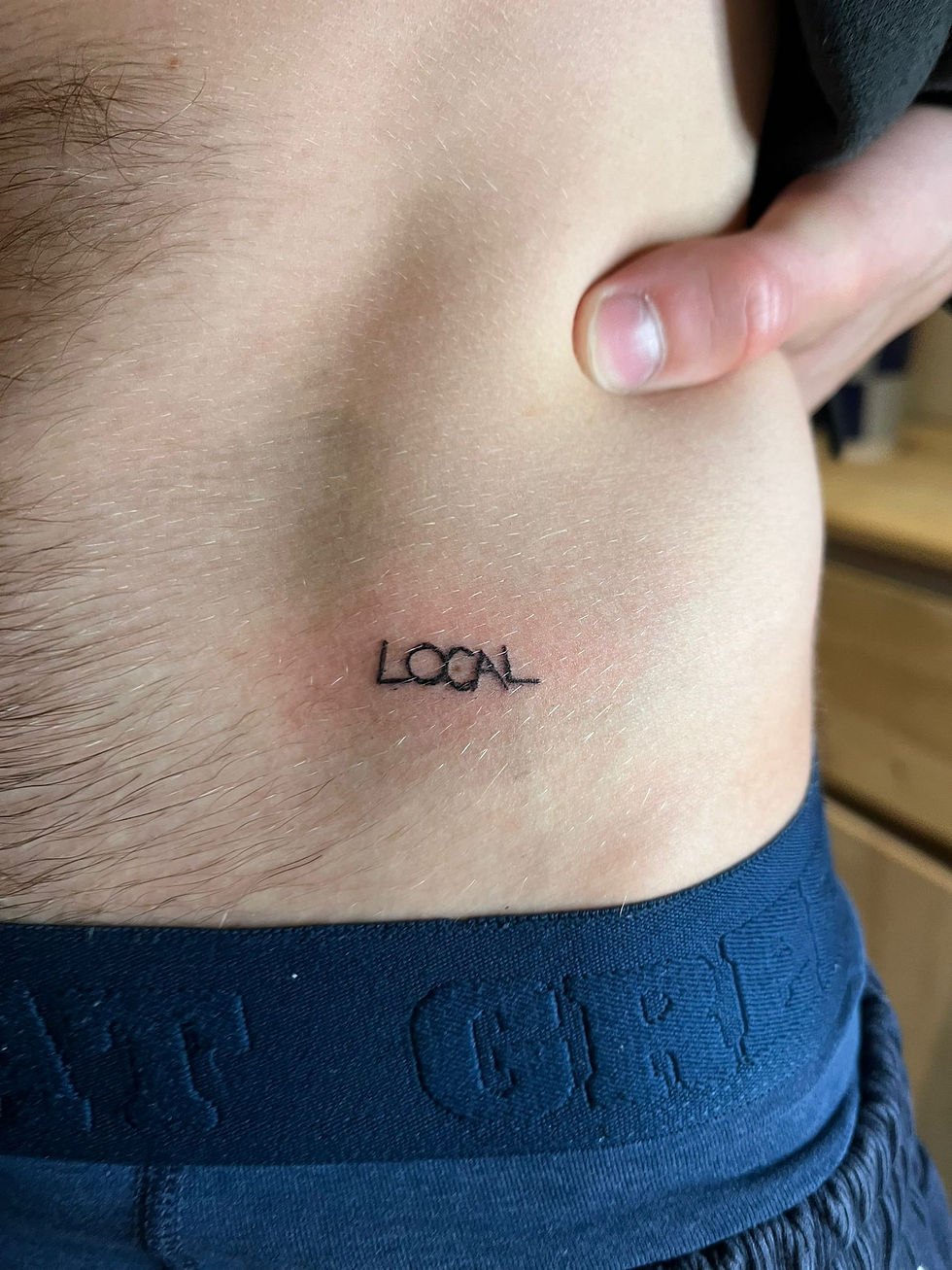
Then came the events, pop-ups, physical spaces, and shared experiences. A community substantial enough that dozens of people across Birmingham now carry Local Boyz tattoos on their skin. The permanence of those tattoos feels significant in an era where creative movements often exist primarily through algorithms, stories and disappearing content. Local Boyz is tangible which is central to nineteen97's understanding of culture.
Building from a Gap
It’s fascinating what can come about when talented people are building from a gap. Recognising a void and creating to fill it out of wanting better for yourself, your city, or your community is the opening line to many stories of culturally impactful movements. For nineteen97 he recognised the gap growing up in Birmingham at a time when examples of successful creative careers felt distant and difficult to imagine. For many young Black creatives like him in the city, visibility itself was a challenge. “All the people that we had as references for people who've made it and got to a point of respect, they didn't look like me,” he says.
Many a time the greatest of talents and highest of ambitions are undermined by a lack of visible, accessible pathways for creative youth. Compound that with Birmingham's position on the periphery of cultural attention and a structural pattern begins to emerge. The talent is abundant, but the networks, recognition and cultural infrastructure that help young people imagine and sustain creative futures are too concentrated in London.
With that being the case, the stories and sounds coming out of Birmingham aren’t reflective of the city’s varying cultural expressions. In the past, Birmingham’s musical identity was often reduced to grime, road rap and narratives rooted in survival. Of course, those stories mattered, but they were not the totality of Black Birmingham life.
“We haven't really had that kind of connective power, especially in Black spaces.”
nineteen97 explains as he recounts Local Boyz emerging partly as a response to that reality. It was birthed from the initiative to create a connective tissue that felt missing.

“I think it stems from people having something to believe in.”
That desire for belief appears repeatedly throughout his reflections. What stuck out to me the most is that Local Boyz is not presented as an organisation with rigid membership or hierarchy. Instead, it functions as a shared point of identification where creative people can recognise themselves and each other.
The importance of that becomes clearer when discussing Birmingham itself. Despite being Britain's second city, Birmingham is often framed through a pervasive absence. nineteen97 acknowledges these realities directly. The city has, in his words, “a shit ton of problems.” Lack of infrastructure. Lack of understanding. Limited support systems. Yet he rejects the idea that infrastructure must arrive from elsewhere because Birmingham is second to none.
“Infrastructure is something that you can create.” This is perhaps the defining idea running through everything he says.
The Sound of Figuring It Out
nineteen97's own route into music was indirect. Before recording songs, he spent years immersed in graphic design, working with artists he admired from as young as fourteen. Design became both a creative outlet and entry point into music.
His multidisciplinary background remains visible in how he thinks about artistic practice as he approaches culture holistically rather than treating music as an isolated medium. It is this very experimentation his own musical language emerged through. The sound he later named “grit” was the result of lived experience.
“There was no intention behind the sound,” he says. “We were just trying to figure it out.”
He traces part of its influence to the atmospheric electronic work of producer Burial, who left a lasting impression but grit's defining qualities came from somewhere more personal. Around 2023 and 2024, after stepping away from music for a period, nineteen97 found himself making work that reflected his emotional reality more directly.
“I just started talking about what was going on in my life.”

The resulting music carried darkness, introspection and tension. Train-track noises. Unsettling textures. Sonic imperfections. Sounds that felt grounded in uncertainty.
When asked to define grit, his answer is revealing. “Something quite damaged, but hardened.” The phrase could easily describe Birmingham itself or perhaps an entire generation. nineteen97 views the genre as reflective of the city's emotional landscape. Not simply sadness, but perseverance of young people attempting to navigate uncertainty while continuing to move forward.
“A lot of young people are really just trying to figure it out.”
As a city shaped heavily by migration, Birmingham contains large communities of second-generation young adults negotiating questions of identity, belonging and future-making. nineteen97 hears those tensions echoed back through the people engaging with grit. The sound may have emerged accidentally, but its resonance appears rooted in shared experience.
Local Day and the Politics of Joy
Local Day comes and deliberately moves away from some of grit's darker emotional territory.
nineteen97 is clear when defining the projects sound.
“The tape's not grit.”
While his solo work often occupies introspective spaces, Local Day functions differently. The project gathers longtime friends who have spent years growing alongside one another creatively into an atmosphere that is lighter, more celebratory and more communal.
“When I'm in sessions with my friends, I'm not reflecting on all the darkness.” There’s joy in friendship and there’s joy in creativity. However, joy should not be mistaken for escapism. Within Black British cultural production, joy has often functioned as its own form of resistance. A refusal to allow communities to be represented solely through imposed struggle. I recognise this in Local Day, I hear and feel the commitment to documenting pleasure, humour, friendship and everyday life.
nineteen97 is also conscious of this. The project incorporates multiple influences: Birmingham rap traditions, funky house, bassline, African musical references and the collective's Jamaican and Nigerian cultural backgrounds. The aim is not to create a singular Birmingham identity but to reflect the city's complexity.

“I think people think that Birmingham is the most misunderstood place ever.”
There is humour in the statement, but also frustration as Birmingham frequently exists in public imagination as a place people describe without fully knowing. Its cultural richness is often flattened into stereotypes but Local Day presents something broader. Local Boyz are less concerned with constructing a definitive narrative and are motivated by expanding the frame. They are creating are turning point. As nineteen97 said:
“There’s a lot more going on.”
Real Life Over Algorithms
The most striking aspect of nineteen97's worldview is his relationship to visibility. Contemporary music culture often treats digital growth as the primary measure of success as audiences become followers and engagement becomes currency.
nineteen97's perspective is noticeably different. When discussing the temporary loss of his Instagram account, he speaks with surprising calm that can only come from building tangibility outside of the digital world.
“If I wasn't so focused on the real-life space, I wouldn't be able to.” The statement rests on years of deliberate community-building. Local Boyz has invested heavily in physical experiences: events, activations, collaborations, ciphers, merchandise, gatherings. The movement exists in and outside of rooms, not just on timelines.

“Going directly to the people has always been our best format.”
His philosophy reflects Birmingham's realities. Without the media infrastructure available in larger cultural centres, direct community engagement becomes both necessity and strategy but it also reflects an honourable belief about culture itself:
Communities are not audiences. They are participants.
I enjoyed his rejection of fandom language entirely when describing Local Boyz supporters.
“You're not treating them like fans.” He describes them as members of a wider family and ecosystem. That shift in perspective fundamentally changes the relationship between artist and audience. Culture becomes something created collectively rather than consumed individually.
Refusing the London Narrative
Regional artists are frequently encouraged to view London as the ultimate destination. The logic is familiar: opportunities are concentrated there, visibility is easier to obtain there, careers become more viable there.
nineteen97 understands the argument. He simply refuses to organise his creative life around it.
“I don't think any regional scenes should be chasing London.”
“London's never ignored me as an artist,” he says. “Not solely because of what I did in London. Because of what I did in Birmingham.”
Recognition becomes a consequence of local investment rather than a reason for it.
Throughout the conversation, he returns to the importance of bringing energy back home as opportunities should not be hoarded and connections should not be gatekept. “I believe in absorbing all the energy and bringing it home.”
Circulation rather than accumulation.

Opening the Floodgates
Toward the end of the conversation, nineteen97 is asked what he hopes future generations will say Local Boyz changed.
True to his approach to community and infrastructure his answer moves beyond music entirely. We again touched on ending gatekeeping, social expectations and creative limitations but then he describes the future he hopes people remember.
“The floodgates have been open.”
The metaphor appears several times throughout the interview. Floodgates. New chapters. New regimes. Moments of change where Local Boyz is positioned as THE beginning. Local Day as a project marks the arrival of the turning point.
“This isn't the entire story.”
nineteen97 compares the project to planting a flag; a signal to the world that the story of Birmingham is changing by the work of its people.
For a city often discussed through what it lacks, there is something significant about that posture. It refuses scarcity thinking and cultural pessimism that circumstances have cultivated. Most importantly, it refuses the assumption that infrastructure must be imported and recognises no one can build Birmingham with devotion and authenticity other than its citizens.
The future nineteen97 imagines is one where Birmingham's creative communities recognise their own value and act accordingly.
Looking back, he hopes Local Boyz will be remembered as part of an era when doors opened wider than before and creative people chose collaboration over competition. It will be a time when opportunities circulated and long may it continue. Local Boyz are the stamp of young Black creatives seeing pathways that previous generations struggled to find.
In that sense, Local Day is an archival record of a particular cultural moment in Birmingham: a city still defining itself, a generation building what it needs, and a collective determined to prove that meaningful infrastructure can begin with something as simple as friends deciding to believe in one another.
Local Boyz Birmingham


Comments